Modoc Nation is a Federally Recognized Native American Tribe with Traditional Homelands along the California-Oregon border. Following the Modoc War in 1873, we were forcibly removed from our Homelands and ultimately relocated to reservation lands in northeast Oklahoma. For more than 10 years now, we have worked to reconnect with our Ancestral Homelands. In 2017, we began purchasing land within our Homelands. In 2021, we formally established the Homelands Program to support our reconnection efforts. The Homelands Program works to steward the natural and cultural landscape and strengthen Modoc cultural connection.
The mission of the Modoc Nation Homelands Program is to reconnect Modoc People with the Traditional homelands our ancestors have cared for since time immemorial through cultural stewardship, conservation, and responsible land management, fostering the health of the land, the well-being of our people, and preserving our heritage for generations to come.
The ancestral home of the Modoc Nation, or Captain Jack’s Band of Modoc Indians, consists of over 5,000 square miles along what is now the California-Oregon border. On the west loomed the perennially snowcapped peaks of the majestic Cascade Mountains; to the east was a desert landscape of alkali flats beyond the peaks of the Warner Mountains; to the north were towering forests of Ponderosa pines and shores of majestic lakes and the Klamath River; while ancient volcanic landscapes like the Lava Beds, now a National Monument, and the Medicine Lake Highlands (Lani’shwi) to Mount Shasta formed their southern boundary.
The ancestral home of the Modoc Nation, or Captain Jack’s Band of Modoc Indians, consisted of over 5,000 square miles along what is now the California-Oregon border. On the west loomed the perennially snow-capped peaks of the majestic Cascade Mountains; to the east was a barren wasteland of alkali flats scaling to the peaks of the Warner Mountains in the Sierra-Nevada range; towering forests of Ponderosa pines and shores of majestic bodies of water and rivers were to the north while the Lava Beds, now a National Monument, and the Medicine Lake volcano range to Mount Shasta formed their southern boundary.
Rooted in the oral traditions of the Modoc People, this exhibit explores the creation story of Kemush — the world’s creator — alongside the spirit guides who shaped the natural order and the tribes born from his journey.
The Extraordinary Tale of Kemush, the Creator of the World, and the captivating narrative of creation itself transcends generations after the Ancestors of the Modoc people carved it and other symbols into the soft volcanic rock of Petroglyph Point.
According to Modoc legend, it was Kemush that created the first beings. They lived in this world before the creation of humans. Kemush traveled to the underground world, where he selected by hand, the spirits that would make up each of the tribes.
These spirit guides included that of the Frog, Rattlesnake, Mole, Fish, Hawk and Coyote. When Kemush went away, the spirit guides held a counsel that lasted for five years. They made the night and decided that it should be followed by morning. They put the moon and the sun in the sky and they decided the length of the seasons.
Kemush returned from the underground world to make something very special. He took spirits and placed them in a basket on his back. He returned to the land above. These spirits took the form of bones and he scattered the bones in different directions. He named them in the kind of people they would be: the Shasta Tribe, the Warm Springs Tribe, and the Klamath.
The Modoc Nation is the only tribe relocated to Indian Territory from the West Coast of the United States.
The ancestral home of the Modoc Nation, or Captain Jack’s Band of Modoc Indians, consisted of 5,000 square miles along what is now the California-Oregon border.
At the conclusion of the Modoc War, in 1873, where Captain Jack and his band of 60 men were able to withstand an army of over 1,000 men for eight months. Captain Jack and five of his warriors were sentenced to be executed at Fort Klamath, however, President U.S. Grant pardoned two warriors to life in prison at Alcatraz. On October 12, 1873, 153 Modoc were transported, via cattle cars, to Indian Territory. On November 16, 1873, the 2,000-mile early winter journey of the Modoc Prisoners of War finally concluded with their arrival in Baxter Springs, Kansas. Upon their arrival to Indian Territory, the Modoc were placed at the Quapaw Agency until 1874, when 4,000 acres were purchased from the Eastern Shawnee.
Despite the odds against them, the Modoc men, women, and children survived the cruel and harsh times during these early years. They rapidly took hold of their new lives, adapting to the local environment and the ways of the people to survive.
After the Act of March 3, 1909, the United States government allowed the Modoc to return to the Klamath Reservation. Twenty-nine Modoc Indians would depart for Oregon, while the majority would stay in Oklahoma. As the years passed, the Modoc language, customs, and culture were heavily suppressed to conform with their environment in Oklahoma and mostly forgotten.
The Modoc and Klamath Tribes were terminated from federal supervision in 1954. The Modoc of Oklahoma continued to hold a non-federally recognized government and were finally granted federal recognition in May 1978.
More than 150 years after their arrival to Indian Territory, the Modoc Nation has survived the forced removal from their Traditional Homelands and remained resilient, celebrating the accomplishments that have sustained them as a Nation on this land. That same unbreakable tenacity now necessitates we reconnect and again steward our Traditional Homelands.
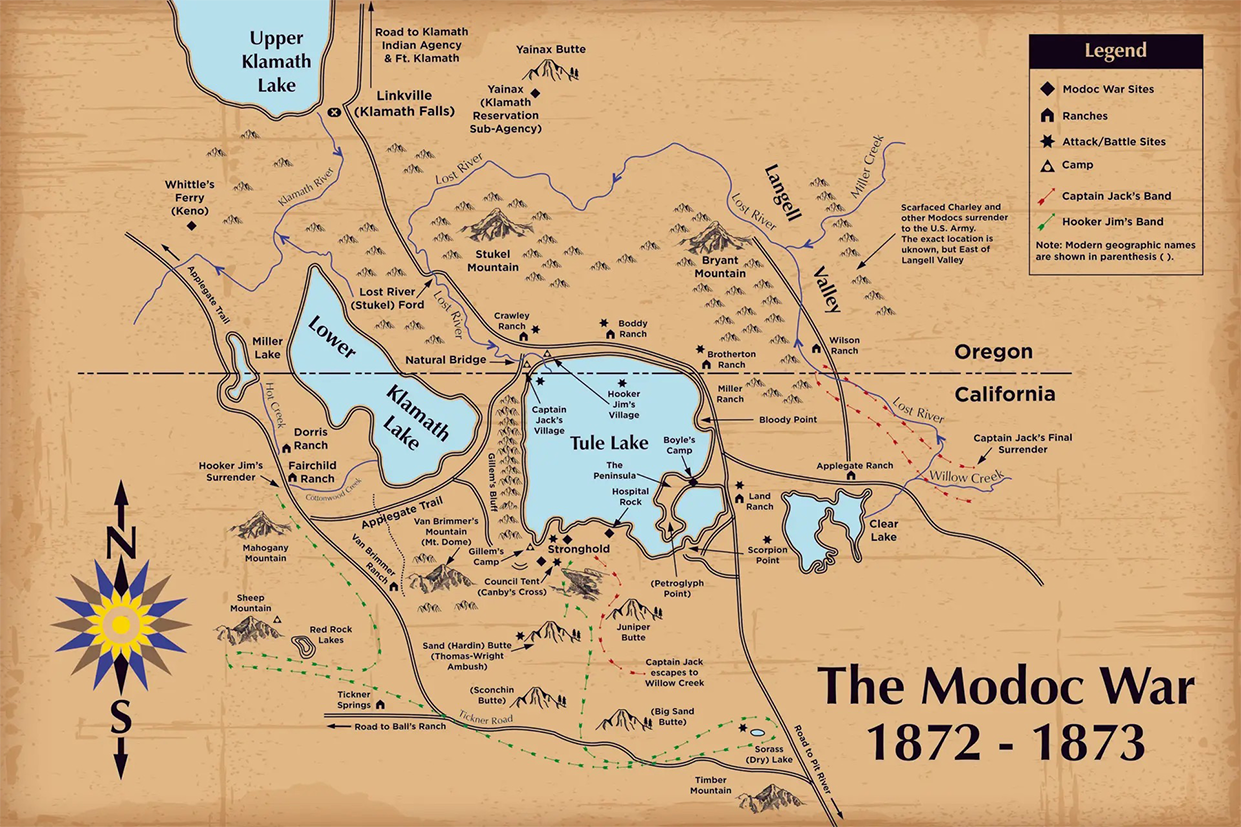
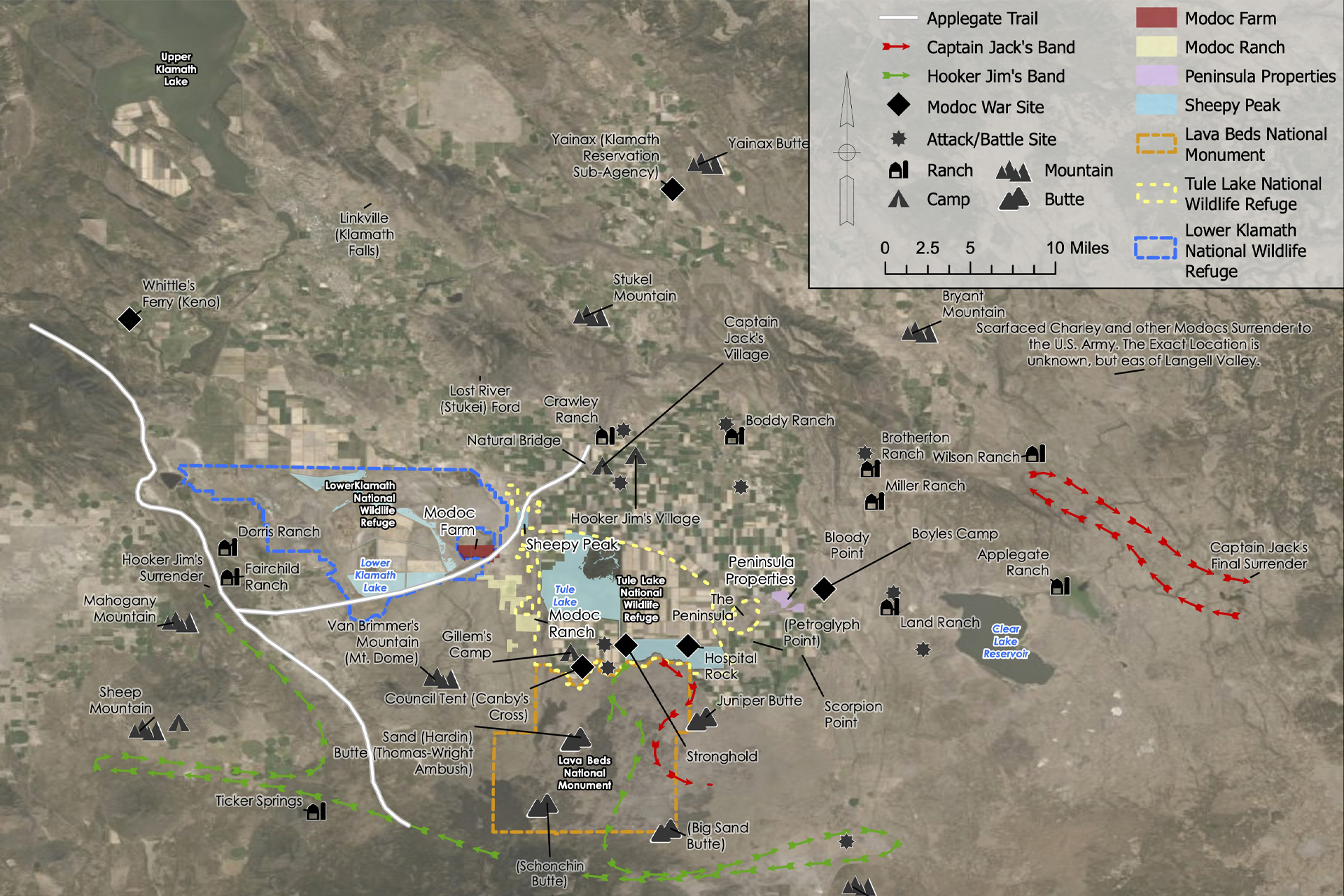
The Modoc Nation is the only tribe relocated to Indian Territory from the West Coast of the United States.
The ancestral home of the Modoc Nation, or Captain Jack’s Band of Modoc Indians, consisted of 5,000 square miles along what is now the California-Oregon border.
In 1873, at the conclusion of the Modoc War, where Captain Jack and his band of 60 men were able to withstand an army of over 1,000 men for over eight months, Captain Jack and five of his warriors were sentenced to be executed. The remaining 155 Modoc were transported to Indian Territory. On November 16, 1873, the 2,000-mile early winter journey of the Modoc Prisoners of War finally concluded with their arrival in Baxter Springs, Kansas via cattle cars. Upon their arrival to Indian Territory, the surviving 153 Modoc were placed at the Quapaw Agency until 1874, when 4,000 acres were purchased from the Eastern Shawnee.
Despite the odds against them, the Modoc men, women, and children survived the cruel and harsh times during these early years. They rapidly took hold of their new lives, adapting to the local environment and the ways of the people to survive.
After the Act of March 3, 1909, the United States government allowed the Modoc to return to the Klamath Reservation. Twenty-nine Modoc Indians would depart for Oregon, while the majority would stay in Oklahoma. As the years passed, the Modoc language, customs, and culture were heavily suppressed to conform with their environment in Oklahoma and mostly forgotten.
The Modoc and Klamath Tribes were terminated from federal supervision in 1954. The Modoc of Oklahoma continued to hold a non-federally recognized government and were finally granted federal recognition in May 1978.
More than 150 years after their arrival to Indian Territory, the Modoc Nation has survived the forced removal from their Traditional Homelands and remained resilient, celebrating the accomplishments that have sustained them as a Nation on this land. That same unbreakable tenacity now necessitates we reconnect and again steward our Traditional Homelands.
Since 2017, Modoc Nation has undertaken efforts to purchase land in northeast California and secure recognition as a California Tribe. This supports Modoc Nation’s desire to bolster reconnection with our Homelands, expand stewardship of the land, and build on progress made in the last 10 years. These efforts have resulted in the purchase of more than 3,000 acres and Costewardship of tens of thousands of acres of now federally managed lands.
We are guided by the traditional knowledge of our ancestors reappropriated day by day and carefully archived for future generations. Sustainable land practices like regenerative agriculture and cultural burning have always been part of who we are. Our Costewardship Landscape offers innumerable examples of intricately tended first foods horticulture associated with every village site, every Modoc home. The non-archeological cultural resource values are at the heart of our restoration and reconnection efforts.
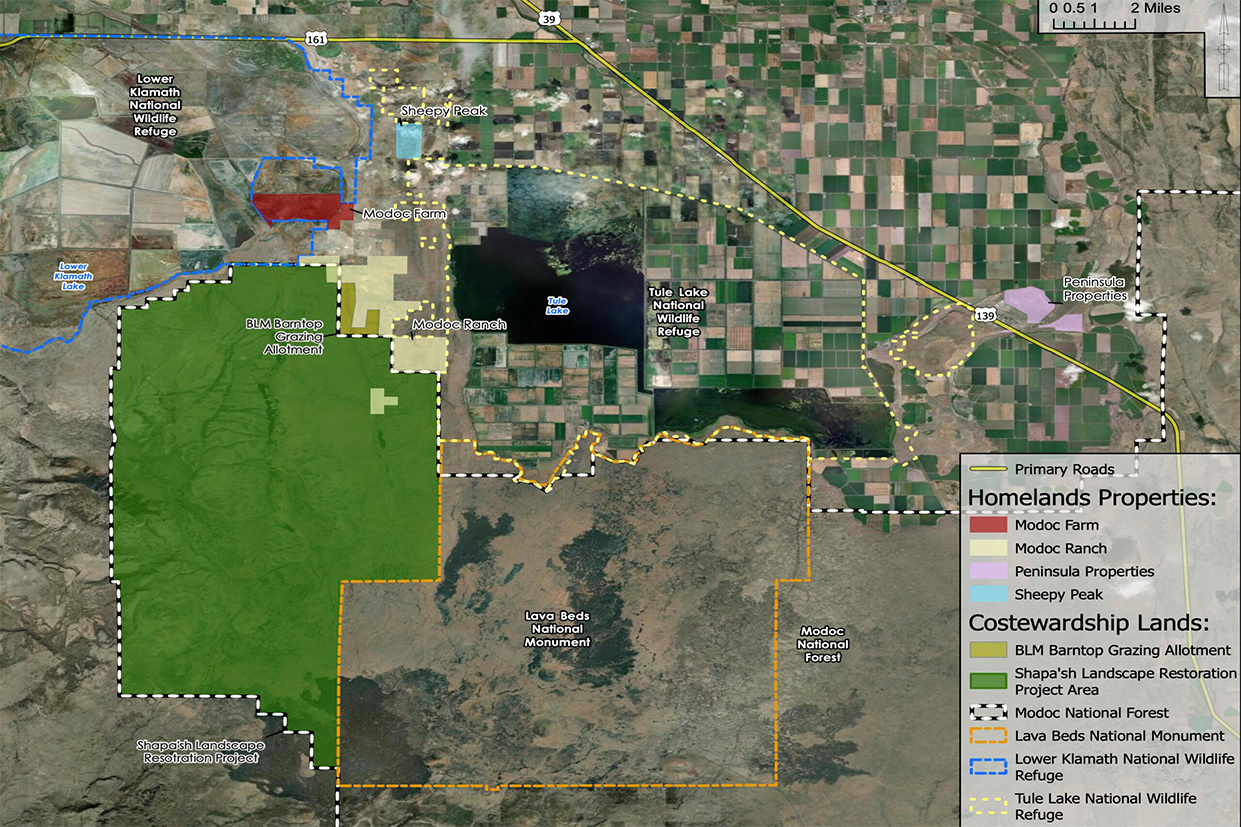
Since 2017, Modoc Nation has undertaken efforts to purchase land in northeast California and secure recognition as a California Tribe. This supports Modoc Nation’s desire to bolster reconnection with our Homelands, expand stewardship of the land, and build on progress made in the last 10 years. These efforts have resulted in the purchase of more than 3,000 acres and Costewardship of tens of thousands of acres of now federally managed lands.
We are guided by the traditional knowledge of our ancestors reappropriated day by day and carefully archived for future generations. Sustainable land practices like regenerative agriculture and cultural burning have always been part of who we are. Our Costewardship Landscape offers innumerable examples of intricately tended first foods horticulture associated with every village site, every Modoc home. The non-archeological cultural resource values are at the heart of our restoration and reconnection efforts.
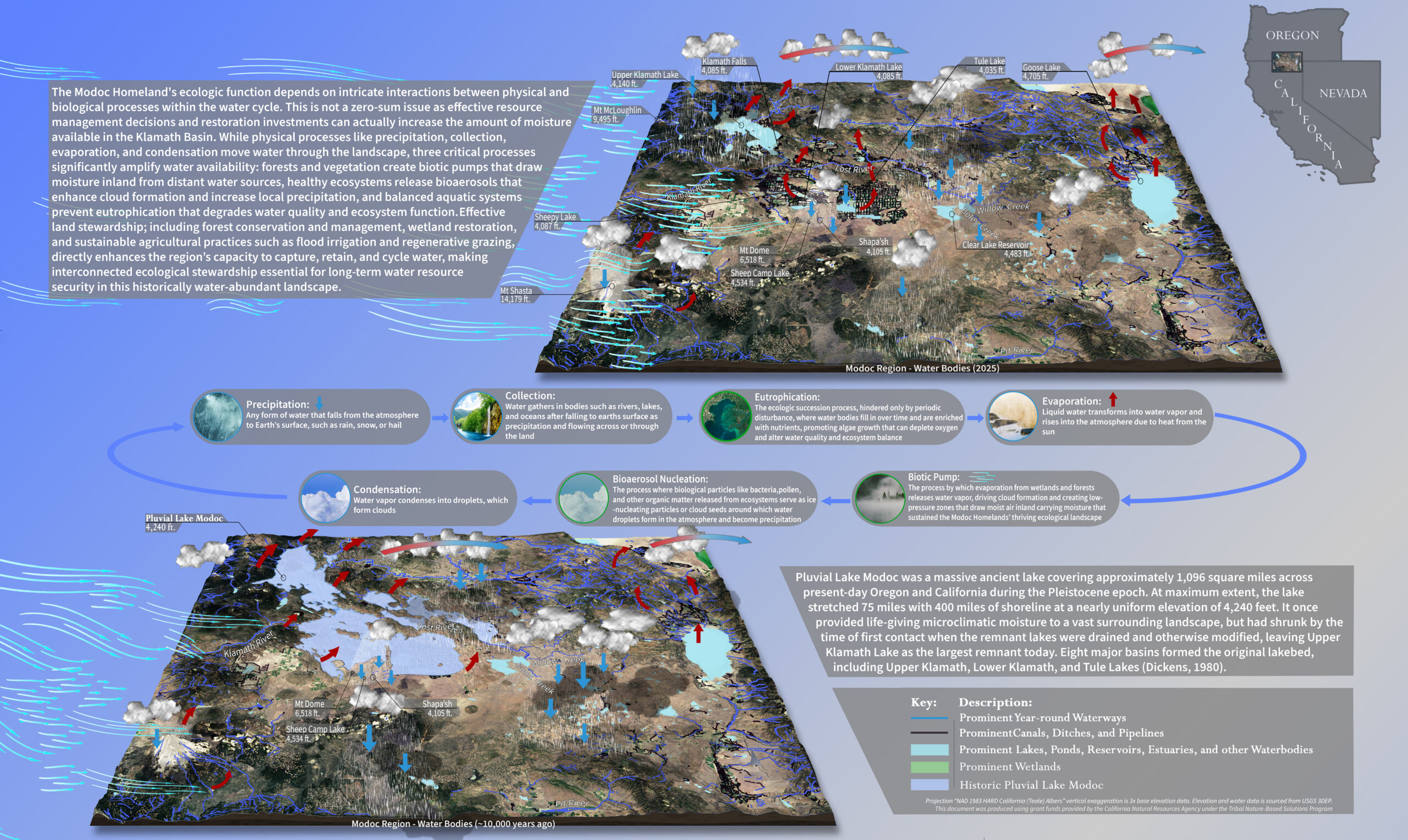
The entire Modoc Homelands, Lost River, and Klamath watersheds are inextricably interconnected and interdependent. Much of the ecologic interconnectedness that made our Homelands almost perfectly resilient to drought and flood has been severed. The Modoc Homelands have born among the greatest impacts of tough decisions for endangered species in other parts of the Klamath Basin. Our Homelands efforts center around providing indigenous advocacy for the Modoc Homelands and calling attention to the integral ecosystem services they once provided.
Focus on expanding Modoc Nation’s land base within its Homelands and strengthening traditional stewardship of the landscape. As more land comes under Modoc Nation’s stewardship, it forms a connected network of cultural and ecological sites where restoration, cultural programing, and funding become more effective and mutually reinforcing, enhancing Modoc presence in the landscape that structured Modoc lifeways and stewardship since time immemorial.
Restore the landscape to support habitat recovery and undesirable species control. Vegetation management, such as regenerative grazing practices, hand crew work, and cultural/prescribed burning are likely to serve as a cornerstone of the landscape restoration effort.
Conduct archival and digitization work to preserve historic documents, maps, and oral traditions, making them accessible to the Modoc community. This also involves other efforts to help the Modoc community enhance reconnection with their Homelands.
Restore culturally significant native plants, including first foods, grasses, and medicinal species.
Invest in resources needed to sustain and expand the Homelands Program, such as staffing, technical skills, funding, equipment, and infrastructure.

The Shapa’sh Costewardship Landscape once hosted many bighorn sheep, known as ku’il in Modoc. Sheepy Ridge and other places and people associated with this landscape were named for them. Our wildlife habitat restoration projects are designed to support all species, but wild sheep reintroduction is among the ultimate goals. Though it has been unsuccessfully tried here in the past, our purchase of these strategic properties means California bighorn sheep translocations can be considered once again in the Modoc Homelands.
Integrated resource management planning and Costewardship partnerships for landscape-scale National Environmental Policy Act documentation lay the groundwork for active restoration work by Modoc People on Modoc lands.


Our Homelands hold the stories of our Ancestors. We carry forward that wisdom, honoring the past to restore the present and protect the future.
Access to clean, reliable water is the foundation of everything. Wells in disrepair are being repaired, watersheds are being restored, and contracts for irrigation water are being developed for wetlands restoration, bringing critical natural water processes back to the land and the people who tend to it.
Neglected land doesn’t just look different, it feels different underfoot. Years of damage had left the soil compacted, depleted, and struggling to support much of anything. Through careful work and attention, the soil has been brought back to a state where it can retain water to grow and sustain life the way it once did.
Growing your own food is about more than just eating. It’s about independence, identity, and connection to the land. Planning is underway to develop the Homeland into a space where the Modoc People tend and utilize first foods on their own terms, rooted in the traditions and knowledge passed down through generations.


Our Homelands hold the stories of our ancestors, and it is our responsibility to carry those stories forward through the work we do every day. Stewardship is not just a word to us. It is a practice, a commitment, and a way of life that has been passed down through generations. Every survey completed, every invasive weed removed, every fence fixed, every cultural burn or repaired road is an act of care rooted in who we are and where we come from. We are not just restoring land. We are restoring a relationship between our people and the place that has always defined us, and we are doing it the right way, on our own terms. We are taking back our Heritage through active natural and cultural resource stewardship.

Before we could restore natural and cultural resources, we need to know exactly what is out there. Archeological and other resource surveys help us reappropriate and sustainably protect what is rightfully ours.

The land we are restoring belongs to more than just us. Wildlife-friendly fencing is being put in place to manage the land responsibly while allowing the animals who have always shared this space to move through it freely and safely, the way they always have.

We are bringing life back to the soil by working with it, not against it. Regenerative grazing practices are being used to naturally restore the health of the land, cycling nutrients back into the ground and enhancing native while controlling invasive and encroaching vegetation, helping the ecosystem rebuild itself from the roots up.
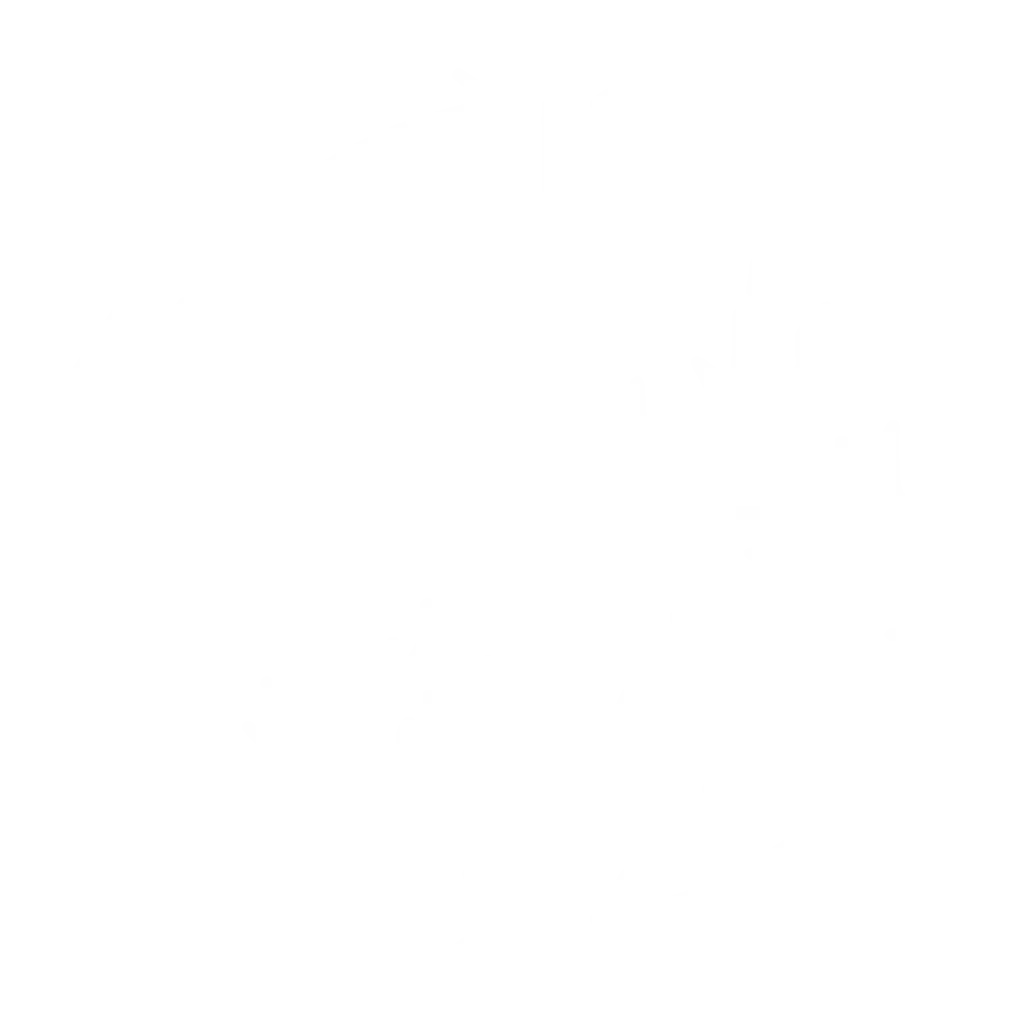
Fire has always been part of how our people have cared for the land. With the help of other tribes and government agencies, controlled, culturally informed fire is being used to tend first foods, clear overgrowth, reduce wildfire risk, and return nutrients to the soil, carrying forward a practice our Ancestors understood long before it became modern land management.
Invasive and encroaching plants had taken hold across much of the Homelands, crowding out native species and draining the soil of what it needs. We are working to remove that overgrowth and rebuild the soil so that native plants can return and the land can support life the way it was meant to.
A healthy Homeland needs more than healthy soil. Roads, structures, and basic infrastructure that had been left to deteriorate are being repaired and brought back into working order, making it possible for our people to access, work, and live on the land we are reclaiming.
Before we could restore the land, we had to know exactly what we were working with. Boundary surveys have been completed to clearly define the edges of our homeland, giving us the foundation we need to move forward with intention and protect what is rightfully ours.
The land we are restoring belongs to more than just us. Wildlife-friendly fencing has been put in place to manage the land responsibly while allowing the animals that have always shared this space to move through it freely and safely, the way they always have.
We are bringing life back to the soil by working with it, not against it. Regenerative grazing practices are being used to naturally restore the health of the land, cycling nutrients back into the ground and helping the ecosystem rebuild itself from the roots up.
Fire has always been part of how our people have cared for the land. Controlled, culturally informed burns are being used to clear overgrowth, reduce wildfire risk, and return nutrients to the soil, carrying forward a practice our ancestors understood long before it became modern land management.
Invasive plants had taken hold across much of the land, crowding out native species and draining the soil of what it needs. We are working to remove that overgrowth and rebuild the soil so that native plants can return and the land can support life the way it was meant to.
A healthy homeland needs more than healthy soil. Roads, structures, and basic infrastructure that had been left to deteriorate are being repaired and brought back into working order, making it possible for our people to access, work, and live on the land we are reclaiming.
As we actively work to restore the land, we are focused on planning larger-scale restoration projects. Some of the projects that we are actively planning and preparing for implementation include the following:
We intend to restore Modoc Farm, a currently dewatered portion of Lower Klamath Lakebed, to its historic function of wetland habitat that also functions as a first foods farm. This will provide habitat for fish and wildlife, improve water quality and flows, preserve open space, support recreation and environmental education, and allow Modoc People to steward and utilize culturally significant traditional resources.
We intend to restore Fleeners Place to its historic function as a wet meadow. The property, owned by Modoc Nation, currently exhibits degraded habitat. This project will utilize process-based restoration strategies to help re-establish natural processes and ecosystem functions and provide a template for similar collaborative restoration efforts across the Modoc Homelands in the future.
We are partnering with the U.S. Forest Service on a Costewardship effort to restore wildlife habitat and native brush-steppe ecosystems within a 39,000-acre portion of Modoc National Forest. Due to exclusion of healthy fire from the project area, encroaching western juniper and invasive species have displaced native brush-steppe communities, increasing wildfire risk and degrading wildlife habitat. The project will help reduce fuels, restore wildlife habitat, and protect first foods and other traditional cultural resources.
We are working with all willing stakeholders to restore watercourses and habitat to better support culturally significant and endangered species in the Modoc Plateau. The Modoc Plateau is high-desert brush-steppe ecosystem which hosts critically reduced sucker fish and sage grouse populations as well as other native species.
We intend to improve Modoc Ranch to provide housing units and associated infrastructure for temporary workforce staff and visitors, as well as offices from which staff and visitors can operate. This will improve our operations and increase engagement, with a focus on sustainable development.
The land remembers what our people have always known. Through youth education, ceremonies like ancestral runs, archeological efforts, and the preservation of our heritage sites, we are keeping that memory alive for every generation to come.
We are investing in the next generation by bringing them back to the land and teaching them the history, values, and traditions that have always defined who we are as a people.
These runs follow the same paths our ancestors traveled long before us. They are a living tradition, connecting our people to the land and to each other through movement, memory, and shared history.
The sites where our ancestors once gathered and built their lives are still here. We are working to identify, protect, and preserve these places so that the story of our people remains written in the land where it began.
We are investing in the next generation by bringing them back to the land and teaching them the history, values, and traditions that have always defined who we are as a people.
These runs follow the same paths our ancestors traveled long before us. They are a living tradition, connecting our people to the land and to each other through movement, memory, and shared history.
The sites where our ancestors once gathered and built their lives are still here. We are working to identify, protect, and preserve these places so that the story of our people remains written in the land where it began.
For generations, the Modoc people maintained a deep and living relationship with their Traditional Homelands. This film follows their return to that land: cleaning what was neglected, restoring what was lost, and reclaiming the responsibility of stewardship. It traces the reintroduction of wildlife, the return of water, and the removal of barriers that kept salmon and sucker fish from their ancient runs. Woven throughout are the traditional knowledge, creation stories, and cultural practices that never disappeared, only waited. Witness stewardship not as a conservation project, but as a living, ongoing act of sovereignty and healing. This is the story of a people who are still here, caring once again for the lands their ancestors were created to steward.
Stewardship is a long-term commitment that guides everything we do. We believe caring for our Homelands means being thoughtful about the decisions we make today while keeping future generations in mind. By protecting natural resources, honoring the history and traditions connected to the land, and investing in the well-being of our communities, we help ensure these places remain strong and vibrant for lifetimes. Our responsibility does not end with the present. It is an ongoing promise to care for our Homelands with respect, dedication, and purpose today, tomorrow, and for generations to come.
Modoc Nation intends to pursue Costewardship opportunities with other landowners, recognizing that management of resources within the Homelands are intricately interdependent. Working together and expanding Costewardship will support efforts to restore wildlife habitat and traditional cultural resources, leverage shared resources, create a more consistent land management approach across management boundaries, and help synergize the interests of various stakeholders.
Every acre restored, every project completed, and every partnership formed helps bring the Modoc Nation closer to its vision of a thriving and sustainable Homeland. Together, we are reclaiming, restoring, and stewarding lands that carry the history, culture, and resilience of our people. If you share our commitment to conservation, cultural preservation, and long-term stewardship, we invite you to connect with us. Join our efforts, explore partnership opportunities, or reach out to learn how you can be part of this important work.